Get free quotes from mobile imaging near you
Takes about a minute. Free, no obligation; providers reply to you directly.
The first time I called a scheduler for mobile imaging, I assumed it would feel like ordering a rideshare — tap a button, someone shows up. Instead, the intake coordinator asked me six questions I wasn’t ready for: the patient’s weight, mobility status, the facility’s radiation room or available space, the ordering physician’s NPI, the insurance carrier, and whether we needed a stat read or routine turnaround. I had answers for maybe two of them.
That gap between “I need an X-ray done here” and “we’re ready to send a tech” is where most first-time buyers get surprised. It doesn’t have to be.
The Short Version:Hiring a mobile X-ray service takes one phone call to initiate and anywhere from a few hours to the next morning to complete, depending on urgency. The process has five real steps, and the biggest delays almost always come from missing clinical paperwork — not from the provider’s side.
Key Takeaways
- Most reputable providers operate 24/7 and can dispatch same-day for urgent needs
- You’ll need an ordering physician’s information before the tech can legally perform the study
- Turnaround on the radiology read is typically 24 hours routine, faster for stat orders
- Insurance and billing happen on the back end — you’re not usually paying out of pocket at dispatch
The 5-Step Process, Start to Finish
Step 1: The Intake Call (5–15 minutes)
One phone call starts everything. Providers like Mobile X-Rays On Demand run their service request lines 24 hours a day — that’s not marketing copy, that’s the actual operational model. Skilled nursing facilities and home health agencies are their bread and butter, and clinical needs don’t wait for business hours.
What you’ll need on that call:
- Patient name, date of birth, weight, and mobility status
- Facility address or home address with access notes (elevator, locked unit, etc.)
- The ordering physician’s name and NPI number
- Diagnosis or reason for study (ICD-10 code if you have it)
- Insurance information
- Whether you need routine or stat turnaround
Nobody tells you this part: if you don’t have the ordering physician’s NPI, the tech cannot legally perform the study. That’s the single most common delay. Keep a reference list of your facility’s ordering providers.
Pro Tip:Build a one-page intake sheet for your staff with all the fields the mobile X-ray provider will ask for. A 15-minute call turns into a 3-minute call the second time.
Step 2: Dispatch and Scheduling (same-day to next morning)
Once intake is complete, the provider’s dispatch team routes the order to the nearest available ARRT-licensed radiologic technologist. For urgent requests at a contracted facility, same-day service is standard. For routine studies — a weekly round of chest X-rays at a SNF, for example — you’re typically scheduling 12–24 hours out.
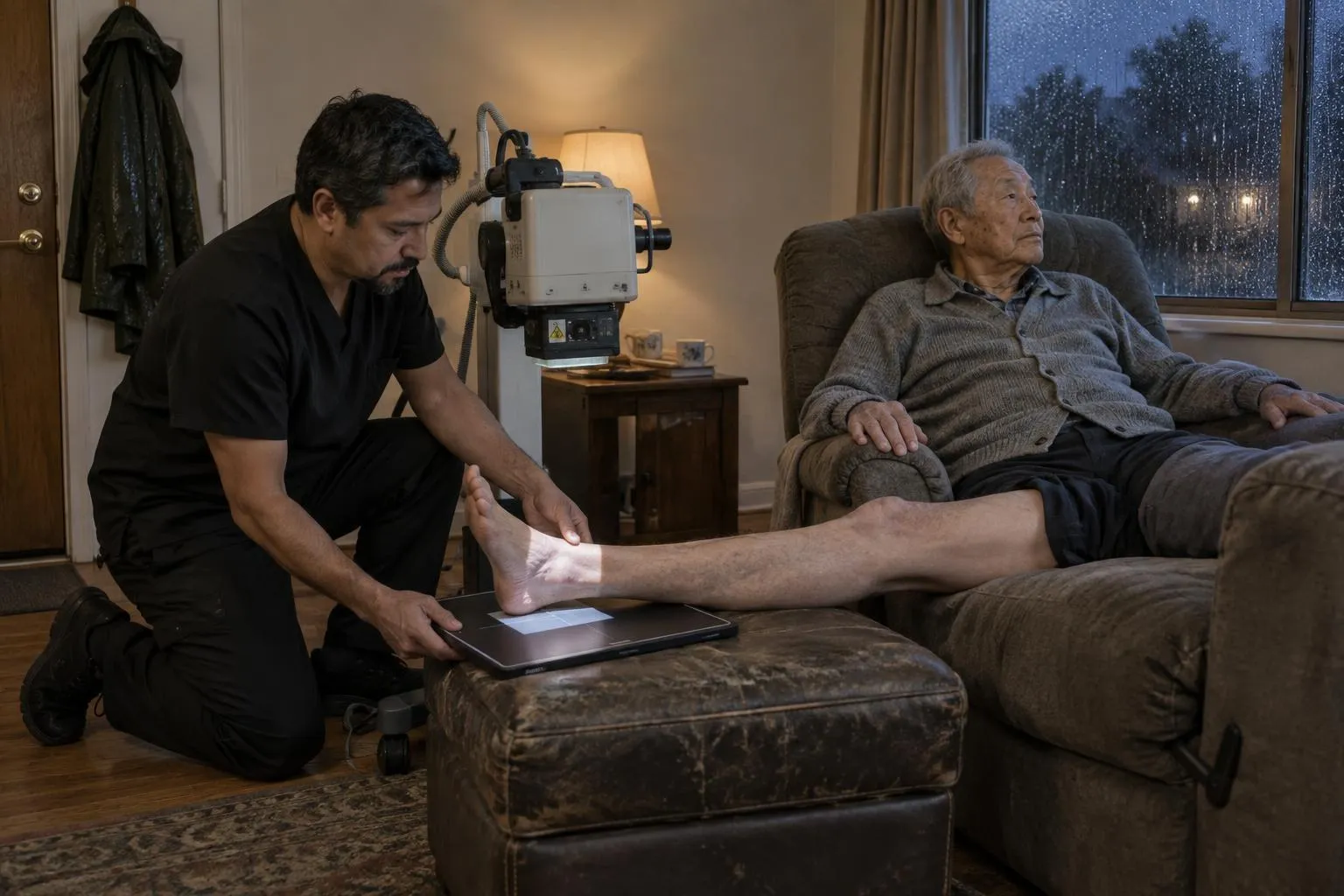
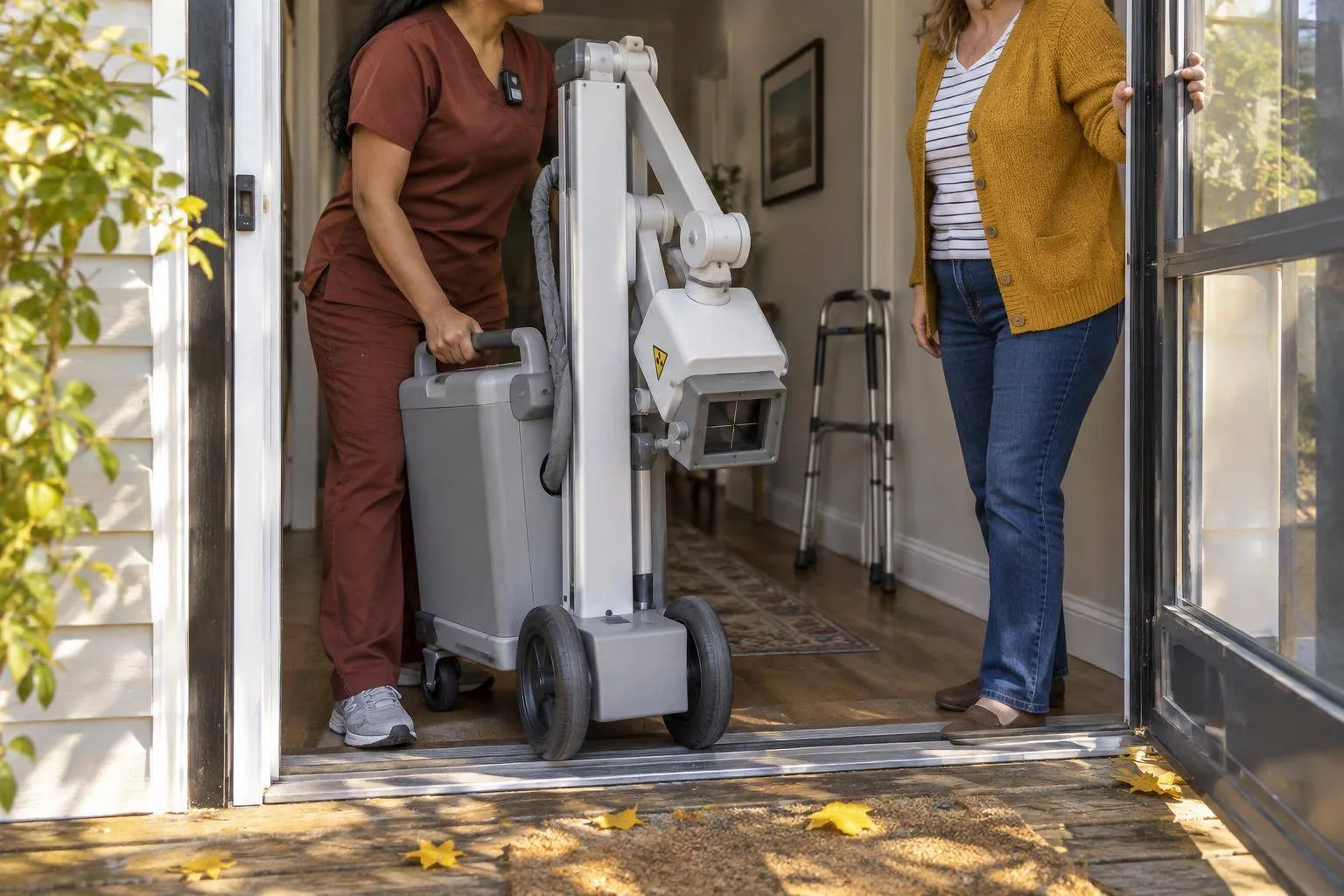
The tech arrives with a portable digital X-ray unit, a mobile workstation, and lead shielding. They need roughly 150–200 square feet of working space and a clear path to the patient. No lead-lined room required, but they will ask other people to step back during exposure.
Reality Check:“24/7 availability” at most providers means you can request service at any hour. Whether a tech is actually available at 3 a.m. on a Sunday depends on the provider’s local coverage and your contract tier. Confirm this before you need it.
Step 3: The Study (15–45 minutes on site)
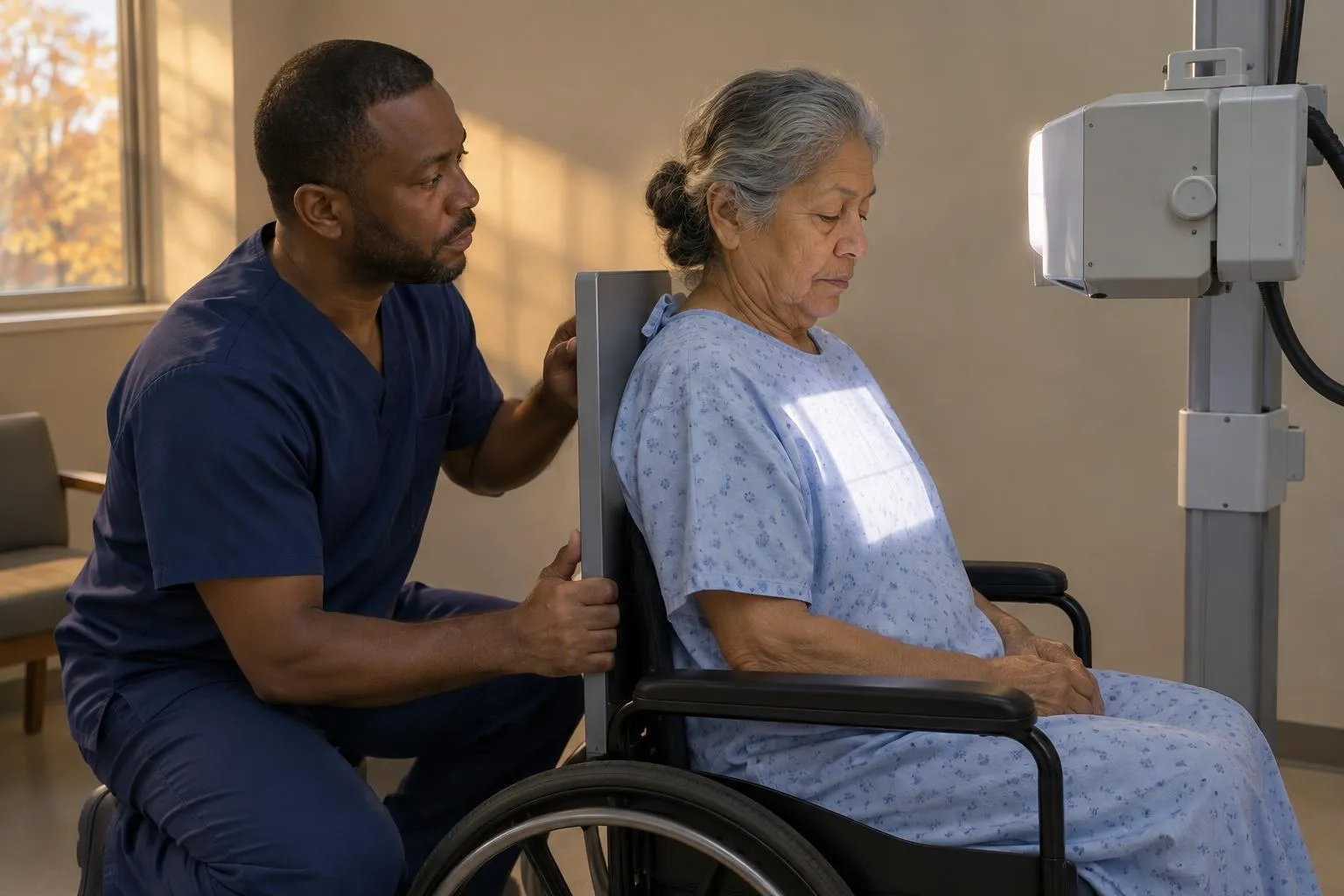
The technologist performs the study, positions the patient, and captures the images on digital equipment. For a standard two-view chest X-ray on a cooperative patient, you’re looking at 15–20 minutes including setup and teardown. More complex studies, patients with limited mobility, or multi-study orders (X-ray + EKG, for example) run longer.
The tech is credentialed through ARRT and licensed in your state. That’s not a nice-to-have — it’s the legal minimum for billing Medicare or Medicaid. If a provider ever sends an uncredentialed tech, that’s a compliance problem for your facility, not just theirs.
Images are transmitted digitally to a contracted radiology group immediately after the study.
Step 4: The Radiology Read (2–48 hours)
Here’s where the two timelines diverge:
| Order Type | Typical Turnaround | Use Case |
|---|---|---|
| Routine | 24–48 hours | Scheduled weekly rounds, non-urgent studies |
| STAT | 1–4 hours | Acute respiratory symptoms, suspected fracture, change in condition |
| Critical finding | Immediate phone call | Pneumothorax, displaced fracture, mass |
A critical finding triggers a direct call to the ordering physician — the radiologist won’t just post the report and move on. That escalation pathway matters. Ask your provider how they handle critical results before you ever need it.
The final radiology report is transmitted to the ordering physician and to your facility’s records system, depending on your integration setup. Most providers send a PDF; some integrate directly into EMR platforms.
Step 5: Billing and Documentation (handled on the back end)
The mobile X-ray provider bills the patient’s insurance directly — Medicare Part B, Medicaid, or commercial insurance. Your facility doesn’t typically see a bill unless there’s a contract fee arrangement or a self-pay patient.
What you do need to retain: the radiology report in the patient’s chart, the technologist’s name and credential, and the date of service. That’s your documentation trail for any subsequent audit.
Reality Check:Medicare enrollment for new portable X-ray providers takes months — including NPI registration, state Department of Health enrollment, and HMO credentialing. This is the provider’s problem to solve before they show up at your door. When vetting a new provider, ask directly: “Are you currently enrolled with Medicare Part B as a portable X-ray supplier?” The answer should be an immediate yes, not a hedge.
What You Need to Provide vs. What They Handle
| Your Responsibility | Provider’s Responsibility |
|---|---|
| Ordering physician’s name + NPI | ARRT-licensed technologist |
| Patient demographics and insurance | Portable digital equipment |
| Clear access to patient | Lead shielding and radiation safety |
| Signed order or verbal order documentation | Image transmission to radiologist |
| Retaining final report in chart | Billing to insurance |
Practical Bottom Line
The process is genuinely simple once you’ve done it once. The friction is almost always front-loaded: missing physician information, unclear access instructions, or not knowing whether you need routine or stat. Fix those on the intake call and everything downstream flows.
If you’re evaluating providers for a facility contract, the questions that separate good from great are: How do you handle critical findings? What’s your credentialing documentation? Are you enrolled with Medicare Part B in this state? What’s your realistic same-day availability at this location?
For a full breakdown of how to evaluate and select a mobile X-ray provider — not just use one — see The Complete Guide to Mobile X-Ray Services.
Done reading? Get quotes from mobile X-ray services near you.
Takes about a minute. Free, no obligation; providers reply to you directly.
Popular cities:
Nick built this directory to help SNF administrators and home health agencies find credentialed mobile imaging providers without wading through services that lack proper ARRT licensure or ACR accreditation — compliance gaps he uncovered when researching portable imaging options for a family member in long-term care.